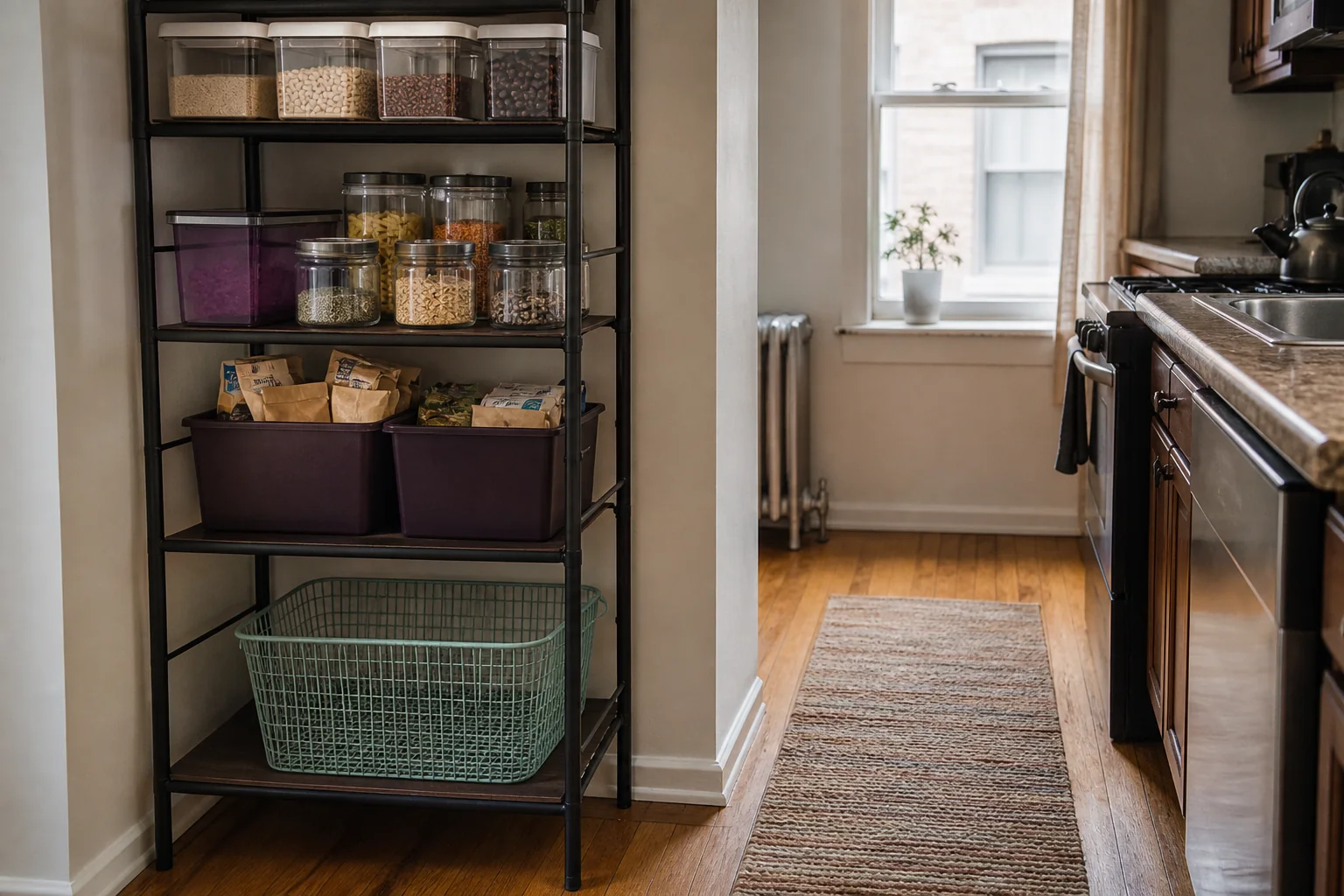
Planning checklist / source synthesis
Measurement Bench
Planning food storage zones with grocery-day slack.
- Planning checklist based on source synthesis.
- No first-hand measurements or tests are claimed.
- Concept illustrations do not count as evidence.
Narrowest shelf or cabinet opening at the top, middle and bottom
Usable shelf width and closed-door depth after hinges, frames and handles
Clear height for the tallest regular package plus the chosen container lid
Exterior width, depth and height of each container rather than its stated volume alone
Distance from each proposed zone to an oven, hot pipe, dishwasher steam, sink or known damp area
Number and footprint of packages normally opened at the same time
Typical quantity of each staple used between shopping trips
Largest normal grocery arrival that must fit before items are unpacked or rotated
Space needed to keep allergen-controlled foods visibly separate for the household
Loaded weight of a bin plus the stable lifting and carrying route from its shelf
Decision rules
- Choose storage away from persistent heat, steam, leaks, household chemicals and rubbish.
- Keep one primary food zone for active packages and one overflow zone for genuine backstock.
- Reserve an empty buffer before grocery day instead of planning storage at permanent maximum capacity.
- Move opened and older suitable stock forward while keeping newer replacements behind it.
- Buy backstock according to actual use rate, available volume and package integrity rather than a visual decanting plan.
- Preserve the ingredient list, allergen statement, date, lot code and preparation instructions whenever food leaves its original package.
- Do not decant when household allergy controls or product identification could become ambiguous.
- Use tightly closed glass, metal or heavy plastic containers when pantry-pest risk or fragile packaging makes added protection useful.
- Inspect food zones for crumbs, damaged packages and pest evidence before adding containers or expanding stock.
- Treat date labels according to the product guidance rather than using one date phrase as a universal safety rule.
Create three zones instead of a pretend pantry
A no-pantry kitchen works better when food has three defined states. The primary zone holds opened packages and the next items likely to be used. The overflow zone holds unopened replacements. The grocery-day buffer stays deliberately empty so new food can land while duplicates, dates and damaged packages are checked.
These zones can occupy different furniture. A cabinet may be the primary zone while one stable freestanding shelf holds overflow. The buffer can be an empty basket or a clear section of shelf. What matters is that food no longer spreads into unrelated cupboards where it becomes invisible.
Choose a cool dry location first
USDA guidance for dry goods calls for a cool, clean and dry place away from extreme heat or cold. University of Minnesota guidance also focuses on package inspection and pest prevention. That makes the top of a hot refrigerator, a cabinet beside an oven and the space under a leaking sink poor default pantry substitutes.
Inspect each proposed zone during normal cooking and dishwashing. Look for steam, warm panels, condensation, water marks, crumbs or pest signs. If the area changes temperature or humidity noticeably then use it for non-food equipment and move food to a more stable measured location.
Measure packages before buying containers
List the foods that actually recur then measure their packages. Record the tallest box, widest bag and number of open packages used in a normal week. Measure shelf openings and closed-door depth at several points. A container that fits the empty interior can still fail at a face frame or hinge.
Compare exterior dimensions rather than advertised capacity because lids, handles and tapered walls consume space. Leave enough height to remove a lid and enough front clearance to lift the container. Deep shelves may work better with one handled category bin than a row of matching canisters that hides the back.
Rotate stock without false precision
Move opened and older suitable packages to the front then place newer replacements behind them. Keep one visible reserve for high-use staples only when the household reliably uses that quantity. The system should expose duplicates before shopping rather than reward filling every available gap.
Date phrases do not carry the same meaning for every food. Follow the label and product guidance for the food in question. Use FoodKeeper or another authoritative food-specific source when timing is unclear. Organisation should preserve information rather than replace it with a universal discard rule.
Decant only when information survives
Clear containers can show stock levels and provide extra protection for fragile packages. They also separate food from the ingredient list, allergen statement, lot code, preparation directions and date. In an allergy-sensitive household losing that connection can create a serious control failure.
Keep food in its original package inside a larger container when practical. If decanting is appropriate then transfer the product name and essential instructions accurately while retaining the original label or a clear photograph until the batch is finished. Never top up a container with a new batch before it is emptied, cleaned as appropriate and relabelled.
Design for pest inspection and cleanup
University of Minnesota Extension advises tightly closed glass, metal or heavy plastic containers for insect-free dry foods and recommends cleaning crumbs or spills promptly. A container can protect food but it does not cure an active infestation. Inspect seams, thin packaging and shelf corners before transferring stock.
When pest evidence appears identify and remove the affected source then clean the full storage area according to authoritative guidance. Do not spray insecticide around exposed food or assume that household remedies solve the source. Include pet food and birdseed in the inspection because stored-product pests can involve those items too.
Keep grocery-day slack visible
An efficient-looking shelf packed to its edge has no room for the next shop or an unusually tall package. Mark one buffer area and treat emptiness there as a working feature. When groceries arrive place dry goods in the buffer first then rotate primary stock and send only verified replacements to overflow.
Review the zones once a week. Return strays, wipe crumbs and move the next suitable item forward. If overflow repeatedly exceeds its boundary then reduce purchase quantities or expand the storage only after re-measuring. Capacity is not the goal. The goal is seeing what exists and reaching it before buying the same item again.
Trade-offs
- Decanting improves visibility and package protection but can disconnect food from essential label information.
- Deep category bins use shelf depth but can hide duplicates and make stock inspection slower.
- A visible grocery buffer looks less full but prevents every shopping trip from causing overflow.
- Separate overflow reduces clutter in the primary zone but adds a second place to inspect before shopping.
- Buying smaller quantities improves rotation but may increase shopping frequency or packaging use.
Who this suits
- Galley and one-wall kitchens that lack a dedicated pantry cabinet.
- Households that need visible separation between active stock, backstock and incoming groceries.
- Readers willing to keep labels and food-specific storage guidance attached to decanted goods.
Who should skip this
- The proposed food zone is damp, pest-affected, under a sink or exposed to persistent appliance heat.
- Decanting would separate food from essential allergen, lot, date or preparation information.
- A high or deep bin would be unsafe to lift at its expected loaded weight.
- The system requires stock quantities greater than the household normally uses.
- The cabinet has active contamination, damaged shelving or chemical storage that must be resolved first.
Format check
Label-preserving sealed container
- The container fits the shelf with its lid fully removable
- Its contents and original label information remain unambiguous
- The filled container can be lifted safely from the assigned height
Who should skip it: Skip decanting when allergens, lot codes, dates or preparation instructions could be lost or confused.
Format check
Handled overflow bin
- The bin holds one measured backstock category
- Every package can be checked without emptying unrelated food
- The loaded bin remains stable and manageable on its shelf
Who should skip it: Skip a deep opaque bin when it will hide duplicate stock or damaged packages.
Sources and claim scope
- Shelf-Stable Food SafetyUSDA Food Safety and Inspection Service
Shelf-stable food still needs suitable packaging and storage conditions after purchase and opening.
- Shelf-Stable Food SafetyUSDA Food Safety and Inspection Service
Dry goods belong in a cool, clean and dry location with added package protection when needed.
- Pantry Pests: Insects Found in Stored FoodUniversity of Minnesota Extension
Pantry-pest prevention includes package inspection, crumb cleanup and tightly closed durable containers.
- Unacceptable Food Storage ContainersPenn State Extension
Food-storage containers should be food-safe, clean, intact and appropriate for the intended contents.
- FoodKeeper AppFoodSafety.gov
Food-specific storage guidance is more reliable than applying one date rule to every pantry item.