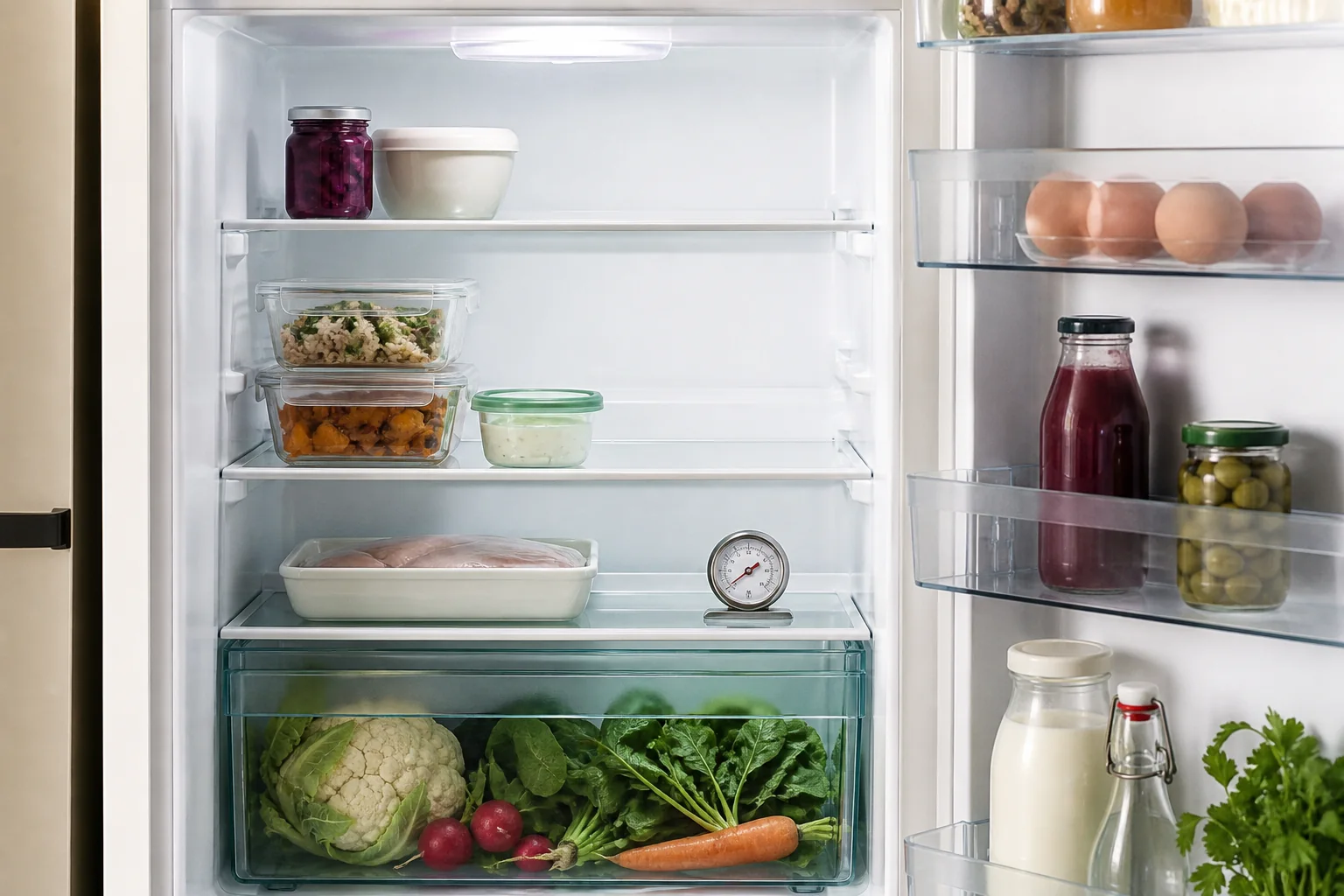
Planning checklist / source synthesis
Measurement Bench
Planning refrigerator zones around temperature and airflow guidance.
- Planning checklist based on source synthesis.
- No first-hand measurements or tests are claimed.
- Concept illustrations do not count as evidence.
Temperature shown by an appliance thermometer
Shelf and drawer width, depth and usable height
Clearance for tall containers and covered dishes
Door swing and drawer-removal path
Typical grocery volume before and after a main shop
Dates on cooked leftovers and opened packages
Decision rules
- Use an appliance thermometer and keep the refrigerator at 40°F or below.
- Leave enough open space for cold air to circulate rather than packing every gap.
- Keep raw meat, poultry and seafood sealed where leaks cannot reach ready-to-eat food.
- Use one flexible shelf section, drawer or bin as grocery-day slack instead of promising a universal empty-space percentage.
- Date cooked leftovers and follow the USDA three-to-four-day refrigerated storage guidance.
- Follow the refrigerator manual when it assigns vents, drawers or temperature zones differently.
Confirm temperature before arranging categories
Use an appliance thermometer rather than assuming the control setting equals the food-storage temperature. The USDA advises keeping the refrigerator at 40°F or below. Check the reading in normal use and follow the appliance manual for placement or adjustment.
Organisation cannot correct a refrigerator that stays too warm. If the unit cannot maintain the target then address the door seal, setting or service issue before relying on a new bin layout.
Protect airflow
The FDA advises against overpacking because cold air needs room to circulate. Do not press tall containers against vents or fill every small gap with a narrow bin. Watch for freezing near cold outlets and warmer zones near the door.
A defined open zone is more adaptable than filling every shelf with fixed containers. Use smaller bins only where they contain a category without walling off airflow or making the coldest areas inaccessible.
Contain raw food rather than relying on one shelf rule
Keep raw meat, poultry and seafood securely wrapped or inside a leak-resistant container. Place the container where a failure cannot drip onto ready-to-eat food. The containment outcome matters more than claiming one shelf position works in every refrigerator.
Use categories only when they preserve this safety boundary. Wipe spills promptly with a method suitable for the appliance surface. An attractive arrangement is not useful if it mixes raw and ready-to-eat items.
Create grocery-day slack
Reserve one drawer, bin or shelf section for irregular packages and the main grocery load. The buffer does not need a fixed percentage because refrigerator size and household shopping patterns vary.
Measure the largest normal shop then keep enough flexible width and height for the items that regularly arrive. Clear expired or unwanted food before the trip rather than forcing new packages into blocked vents and unstable stacks.
Date leftovers and reset the fridge
Date cooked leftovers when they enter the refrigerator. USDA guidance generally places cooked leftovers within a three-to-four-day refrigerated window. Use the food-specific cold-storage chart when the item or condition differs.
During the weekly reset move the next-use items forward, clean spills and restore the flexible zone. If the same category repeatedly overflows then change buying quantity or shelf assignment rather than adding another opaque container.
Trade-offs
- Bins contain leaks but can restrict airflow and hide food.
- Fixed categories improve consistency but reduce grocery-day flexibility.
- Leaving visible slack lowers theoretical capacity but makes changing loads easier to manage.
Who this suits
- Small households that need flexibility after a main grocery trip.
- Readers whose fixed bins leave no room for irregular packages.
- Anyone building organisation around food temperature and separation.
Who should skip this
- The refrigerator cannot maintain 40°F or below.
- A damaged seal, recurring leak or cooling fault needs service.
- The proposed bins block vents or prevent drawers and doors from closing.
- Household medical, allergy or accessibility needs require a different separation system.
Sources and claim scope
- Refrigeration and Food SafetyUSDA Food Safety and Inspection Service
Refrigerators should remain at 40°F or below and food should be arranged to support cold-air circulation.
- Refrigeration and Food SafetyUSDA Food Safety and Inspection Service
Raw meat should be securely wrapped or contained so juices cannot contaminate other food.
- Refrigerator Thermometers: Cold Facts About Food SafetyU.S. Food and Drug Administration
An appliance thermometer helps confirm 40°F or below and overpacking can obstruct cold-air circulation.
- Cold Food Storage ChartsFoodSafety.gov
Cold-storage time depends on the food and storage condition rather than the organiser category.
- Refrigeration and Food SafetyUSDA Food Safety and Inspection Service
Cooked leftovers are generally refrigerated for three to four days.