Planning checklist / source synthesis
Measurement Bench
Planning reversible storage around lease and surface limits.
- Planning checklist based on source synthesis.
- No first-hand measurements or tests are claimed.
- Concept illustrations do not count as evidence.
Total loaded weight including the organiser, containers and normal contents
Surface material, finish, texture, condition and time since painting or coating
Adhesive footprint plus the full downward release-tab path
Distance from the proposed position to steam, water spray, a burner or appliance exhaust
Door thickness and the clear gap above the door for an over-door bracket
Hinge-side clearance, handle path and full door swing with the organiser loaded
Inside span for a tension product at the front, middle and back
Pad contact area and whether both contact surfaces are flat, sound and parallel
Item width, depth and height including handles or packaging
Walking, cooking and cabinet-opening clearance after the storage is installed
Decision rules
- Read the lease and building rules before making any alteration then request written permission when the answer is unclear.
- Prefer a freestanding solution when it solves the same problem without touching a finished surface.
- Treat every adhesive as a product-specific system rather than a general promise that no damage can occur.
- Compare the fully loaded weight with the exact product rating and never combine hooks to invent a higher rating.
- Use only the surfaces, cleaning method, cure time and removal method named by the manufacturer.
- Keep the release tab or removal path visible for the full period of use.
- Avoid valuable, sharp, heavy or breakable items on a removable adhesive fitting.
- Confirm that an over-door unit does not change door closure, hinge movement, seals or the handle path.
- Confirm that a tension product cannot fall into a work path or onto glass, food or a cooking surface.
- Keep stored items away from appliance heat, cooking flames, water spray and unsafe cord routes.
Use a no-drill hierarchy
No-drill storage is a sequence of lower-commitment choices rather than a single product type. Start with a freestanding riser, bin or narrow cart. If floor and shelf space are insufficient then consider an over-door or tension-supported format. Put adhesive products last because their performance depends on a specific finish, preparation process and removal technique.
This order keeps the first experiment easy to reverse. It also separates the real goal from the hardware. If tea supplies cover the prep counter then a handled bin inside an existing cabinet may solve the problem with less risk than attaching a rack to a painted splashback.
Check the lease before the surface
A product label cannot grant permission to alter a rental. Read the clauses on fixtures, painting, adhesives and repairs. Also check building rules that sit outside the lease. When the language is unclear or the proposed item changes a door, cabinet or wall then ask the landlord or property manager for a written answer.
The HUD lease in the source list is an example rather than a universal rule. Local laws and actual tenancy terms differ. Keep the property manager's reply, product instructions and a photograph of the original surface with the move-in records. A reversible intention does not remove responsibility for a mark, peeled finish or hardware failure.
Treat adhesives as surface systems
Manufacturer instructions define compatible surfaces, preparation, waiting time, temperature range, weight rating and removal. Command guidance names specific surfaces and product limits. That evidence applies to those products under those conditions rather than proving that every kitchen adhesive will release cleanly.
Identify the actual surface instead of calling it simply a wall. Painted plasterboard, laminate, sealed tile, grout, wallpaper and cabinet veneer respond differently. Do not apply to peeling paint or a coating with unknown adhesion. Even a permitted small trial is not a guarantee for another position or a longer installation.
Count the real load and the removal path
Weigh the organiser plus its normal contents rather than the empty basket. A hook holding two tools today may collect more over time. Use the rating printed for the exact size and configuration. Do not add hooks together to support an item heavier than the listed limit unless the exact instructions describe that arrangement.
Plan removal on installation day. Stretch-release products require a clear direction and enough exposed tab to follow the stated method. A shelf placed below the tab or a cabinet edge in its path can make correct removal impossible. Keep valuable, sharp or breakable items off fittings whose failure could cause injury or serious loss.
Test tension and over-door formats mechanically
A tension rod transfers force into two contact surfaces. Measure the span in several places and check that the faces are sound, flat and approximately parallel. Follow the product range and load instructions. Do not position a tension rack where a slip would drop items onto food, glass, a hot appliance or a person.
An over-door organiser adds thickness above the door and a moving load on the hinge side. Measure the slab and the gap then close the door slowly with the empty rack fitted. Recheck with the intended load. Stop if the bracket scrapes, the latch no longer aligns, the seal compresses incorrectly or the door swings into another fitting.
Let freestanding storage do more work
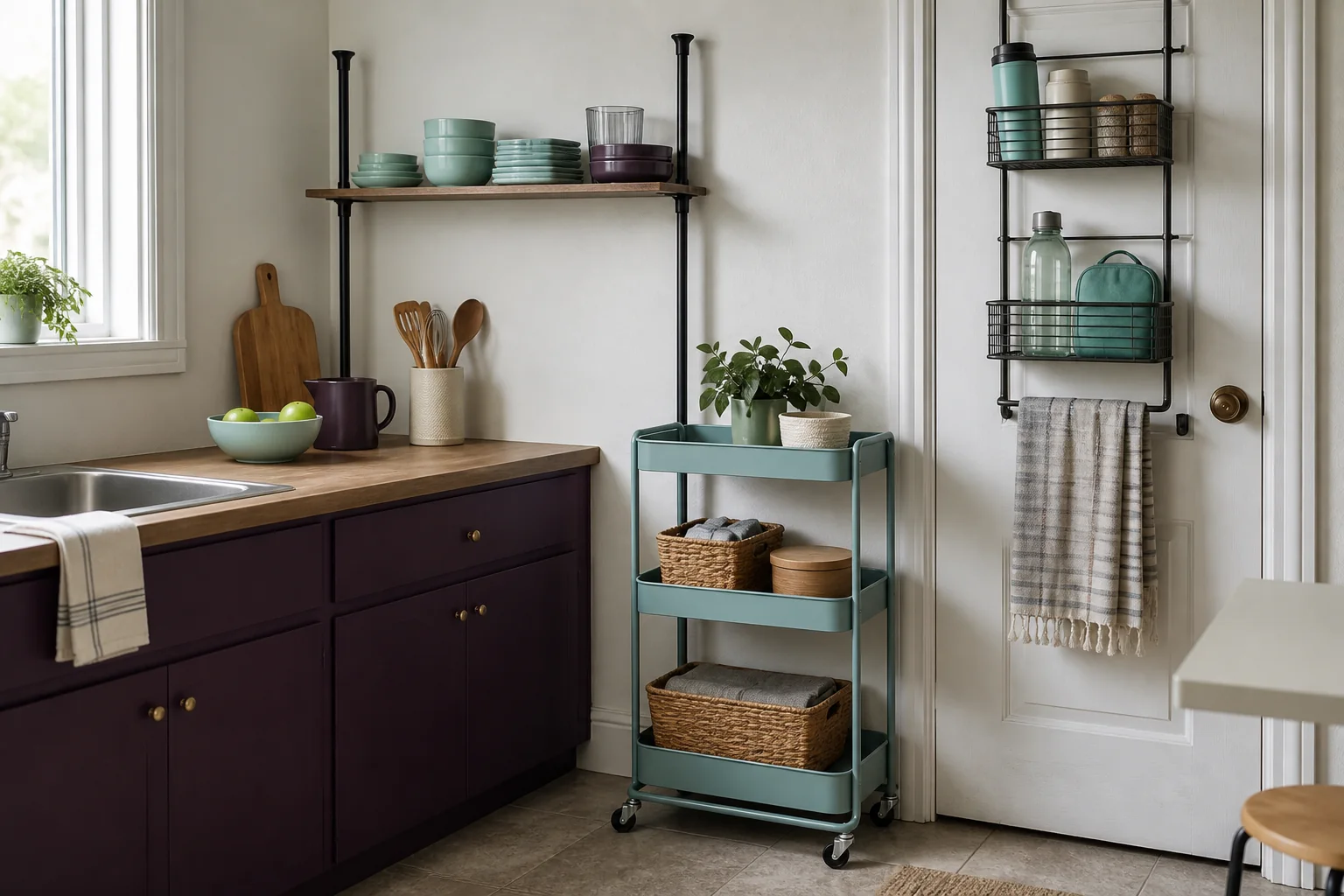
Freestanding pieces avoid adhesive compatibility and can move with the tenant. A narrow cart can hold backstock while a shelf riser can divide an existing cabinet. A handled box can turn a high shelf into a category zone without permanent hardware. Each still needs measured dimensions and a stable loaded position.
The trade-off is footprint. A cart that looks efficient in a product image may narrow a galley aisle or block a cabinet door. Mark the proposed footprint with a removable method suitable for the surface then rehearse cooking, opening the refrigerator and carrying a pan through the space before choosing it.
Design the move-out before installation
Keep the package instructions or save a digital copy with the product name. Photograph the surface before installation and note the date. Do not paint over or caulk around removable hardware. Review the removal method before access becomes blocked by shelves or appliances.
At move-out remove the load first then follow the exact slow-release sequence. Stop if the surface begins lifting and seek product-specific guidance. No-drill can reduce holes but it cannot promise a mark-free result on every finish.
Trade-offs
- Freestanding storage is easy to move but uses floor or shelf footprint.
- Adhesive storage preserves floor space but depends on surface condition and exact removal technique.
- Tension products avoid holes but can slip or mark contact points when the fit or load is wrong.
- Over-door racks add capacity but may affect closure, hinges, seals or nearby walls.
- Keeping loads conservative leaves unused rated capacity but lowers the consequence of gradual overfilling.
Who this suits
- Renters who want a measured sequence of freestanding and removable options.
- Small kitchens where one access problem can be solved without permanent cabinetry changes.
- Households willing to verify the lease, exact surface and full loaded weight before installation.
Who should skip this
- The lease or building rules prohibit the proposed fitting or permission remains unclear.
- The surface is wallpapered, textured, porous, peeling, newly coated or excluded by the exact product instructions.
- The storage would hold heavy, valuable, sharp or breakable items above people or food.
- An over-door rack changes closure, hinge movement, a fire door or an appliance seal.
- A tension or freestanding unit would narrow an escape route, cooking path or required appliance clearance.
Format check
Narrow freestanding cart
- The unit remains stable at its expected loaded weight
- Its footprint leaves the required walking and door clearances
- It can move out without scraping walls or cabinets
Who should skip it: Skip a cart when it narrows the working aisle or creates a trip point near cooking heat.
Format check
Measured over-door rack
- The bracket fits the measured door thickness and top gap
- The door closes freely with the organiser loaded
- Stored items cannot strike the wall, handle or nearby cabinet
Who should skip it: Skip over-door storage when the bracket changes closure, strains the hinge or interferes with a seal.
Format check
Product-specific removable hook
- The exact surface appears on the manufacturer compatibility list
- The full load stays within the specific product rating
- The release tab remains accessible for slow removal
Who should skip it: Skip adhesive storage on wallpaper, textured or damaged finishes and any surface excluded by the instructions.
Sources and claim scope
- How to Use Command Products3M Command
Command products require product-specific surface preparation, waiting time and removal steps.
- Command Medium Replacement Strips3M
Surface compatibility and load guidance belong to the exact adhesive product rather than the whole product category.
- RÅSKOG Utility CartIKEA
Freestanding carts have exact dimensions and load information that must fit the working aisle.
- Model Lease for Subsidized ProgramsU.S. Department of Housing and Urban Development
A model lease shows why alterations and written permission should be checked in the actual tenancy documents.
- Home Electrical Safety ChecklistU.S. Consumer Product Safety Commission
Countertop appliances and their cords should stay away from hot surfaces and sink water unless the exact installation uses the protection described by the source.