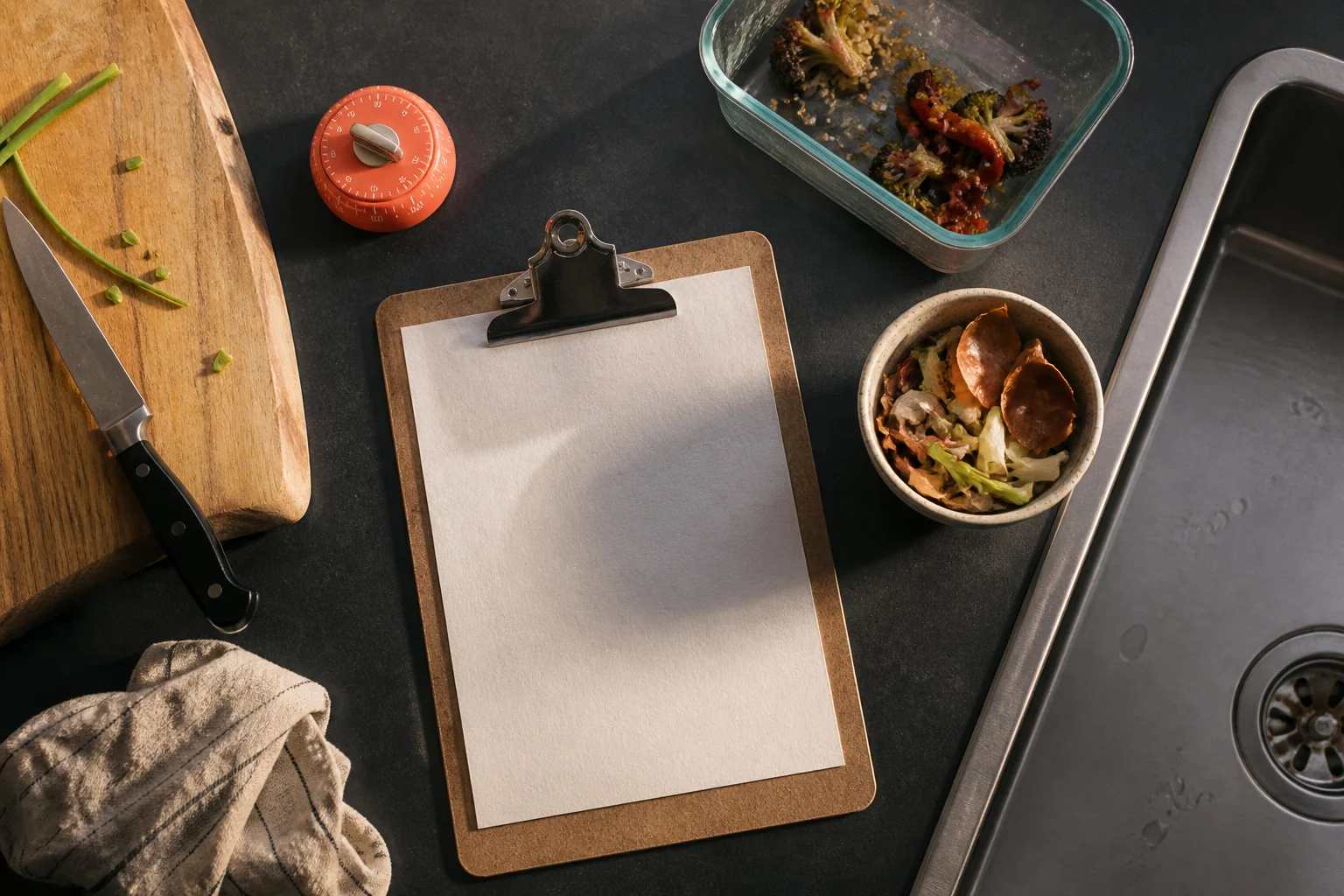
Treat the timer as triage
The reset restores a safe working surface and a usable sink. It is a paced maintenance routine rather than a guarantee that every kitchen can be completed or decontaminated in 20 minutes.
Choose a visible finish line before starting: one clear prep zone, food returned to safe storage and a sink that can be used. Deep cleaning, repairs and pest treatment belong in separate tasks with enough time and appropriate guidance.
Minutes 0 to 4: protect food
Return food that still belongs in cold storage then review dated leftovers. USDA guidance generally places refrigerated cooked leftovers within three to four days. Use food-specific storage guidance when the item or condition differs.
Do not use appearance or smell as the only safety decision. Follow the relevant food-safety guidance and discard food when safe handling is uncertain. Pause the timer when a spill involves broken glass or a serious raw-food contamination issue.
Minutes 4 to 8: clear the prep zone
Move dishes to the sink or dishwasher and remove rubbish from the defined working surface. Keep food, cleaners and loose packaging in separate temporary groups rather than mixing everything into one catch-all basket.
The goal is a continuous washable area for the next task. Do not relocate combustible clutter beside the stovetop or balance sharp tools in an unstable container to beat the timer.
Minutes 8 to 12: return items
Return food, cookware and appliances to their measured zones. Items without a safe home go into a temporary review basket outside the prep area rather than a new counter pile.
Notice repeated drift. When the same item returns every week then its assigned shelf may be too far away, too crowded or difficult to reach. Record the pattern for a later layout change rather than adding storage during the reset.
Minutes 12 to 16: clean the working surface
Clean food-contact surfaces by following the cleaner label and surface instructions. The FoodSafety.gov four-step framework keeps cleaning and food separation visible in the routine.
Never mix bleach with another cleaner or disinfectant. Keep the product in its original labelled container and allow the contact or drying process described by the label rather than rushing it for the timer.
Minutes 16 to 20: close the sink and floor
Use the final block for the sink, rubbish and the most-used floor area. Keep cords, electrical appliances and wet cleaning away from one another. Stop if a leak or electrical concern appears.
Finish by restoring the grocery-day buffer and leaving the printable where the next reset can begin. The useful result is a functional kitchen and a short list of deeper tasks rather than a styled photograph.
Planning checklist / source synthesis
Measurement Bench
Planning a flexible kitchen reset sequence.
- Planning checklist based on source synthesis.
- No first-hand measurements or tests are claimed.
- Concept illustrations do not count as evidence.
One 20-minute timer divided into five adjustable four-minute pacing blocks
A defined prep-zone boundary that should be clear at the end
Dates on cooked leftovers before they return to the refrigerator
The minimum sink, rubbish and floor area needed for normal use
Separate storage locations for household chemicals and food-contact items
Decision rules
- Treat the five four-minute blocks as pacing prompts rather than a safety standard or completion guarantee.
- Deal with refrigerated food and dated leftovers before cosmetic tidying.
- Pause the timer for broken glass, leaks, electrical hazards or serious cross-contamination.
- Follow each cleaner label and keep household chemicals in their original labelled containers.
- Never mix bleach with other cleaners.
- Stop when the kitchen is functional and safe then schedule deep cleaning or repairs separately.
Trade-offs
- A timer encourages focus but cannot replace deep cleaning, repair work or pest treatment.
- Returning everything quickly restores function but may postpone decisions about surplus items.
- A fixed sequence improves consistency but should pause whenever safety needs more attention.
Who this suits
- Small kitchens that need a repeatable weekly functional reset.
- Readers who benefit from short paced maintenance blocks.
- Households using the printable as a flexible prompt rather than a completion test.
Who should skip this
- There is an active leak, electrical hazard or broken glass.
- Serious raw-food cross-contamination needs a dedicated response.
- Pest activity, mould or heavy grease needs more than a timed reset.
- A household chemical is unlabelled or has been mixed with another product.
- The user needs rest, assistance or more time to complete the lifting and cleaning safely.
Sources and claim scope
- 4 Steps to Food SafetyFoodSafety.gov
Food routines should preserve cleaning, separation, cooking and chilling boundaries.
- Refrigeration and Food SafetyUSDA Food Safety and Inspection Service
Cooked leftovers are generally refrigerated for three to four days.
- How to Cut Food Waste and Maintain Food SafetyU.S. Food and Drug Administration
Refrigerated food needs prompt storage plus attention to temperature, packaging and safe holding time.
- Pantry Pests: Insects Found in Stored FoodUniversity of Minnesota Extension
Pantry-pest prevention includes package inspection, crumb cleanup and tightly closed durable containers.
- Cleaning and Disinfecting With BleachCenters for Disease Control and Prevention
Bleach should never be mixed with other cleaners and its label directions control safe dilution and use.