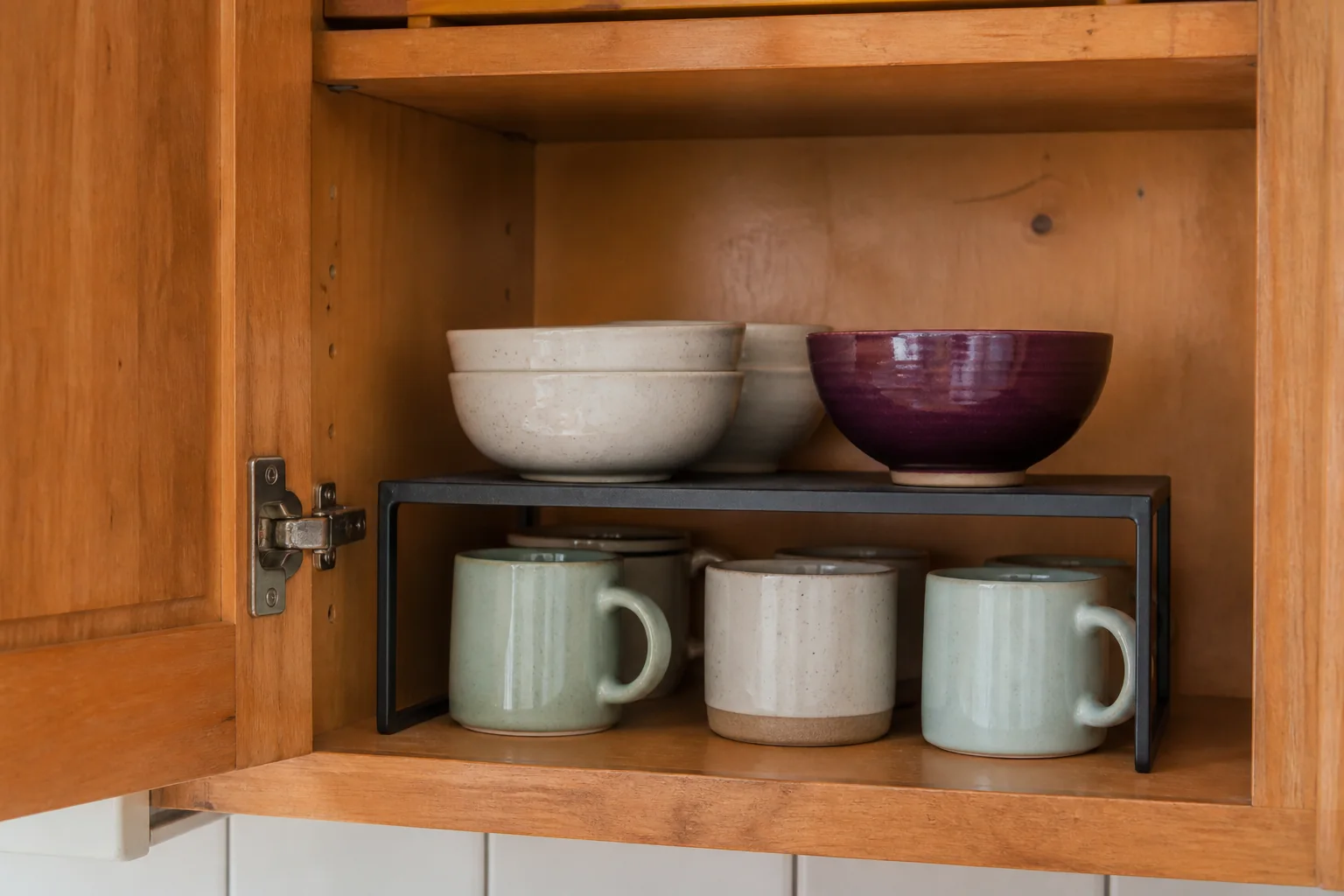
Decision rules
- Choose the format by the access problem rather than advertised capacity.
- Use a riser only when its footprint, stacked-item height and exact load guidance fit the shelf.
- Use a turntable only when it can rotate without striking the door, hinge or surrounding items.
- Use a pull-out only when the exact opening, mounting substrate, extension path and loaded weight meet its installation requirements.
- Test door closure and item stability before treating the organiser as part of the permanent layout.
Choose by failure mode
Match the format to the access problem
| Format | Fits when | Watch for |
|---|---|---|
| Shelf riser | The shelf has safe vertical slack and both levels remain visible and reachable. | Unverified load, unstable stacks, hinge contact and a lower row that becomes harder to reach. |
| Turntable | Stable lightweight items need to rotate from a deep corner to the front. | A blocked rotation path, tall bottles that tip and circular space lost inside a rectangular cabinet. |
| Pull-out | The opening, mounting surface and extension path meet the exact product instructions. | Slide width, mounting limits, plumbing access and a loaded unit that is difficult to control. |
Name the access problem first
Shelf risers solve a height problem, turntables solve a reach problem and pull-outs solve a deep linear-access problem. None is a universal upgrade because each consumes space and moves in a different way.
Empty the target zone and write the failure in one sentence. If the problem is that a second row hides behind the first then rotation may help. If the problem is unused height above short cups then a riser may be the simpler answer.
Choose a shelf riser for vertical slack
A riser can divide tall shelf space into two reachable levels when its feet sit securely and the combined item height remains below the next shelf. Compare the exact footprint with the narrowest opening and hinge path.
It can fail when the back row becomes harder to reach, the shelf is overloaded or tall stacks become unstable. Check the exact product load guidance and the cabinet shelf condition before adding dense dishes or tins.
Choose a turntable for rotation
A turntable can bring stable lightweight items from a deep corner to the front. Measure its complete diameter and rim then test the rotation path with the cabinet door open. Use a paper circle at the listed diameter to expose hinge contact.
It can fail when tall items tip, the rim collides with a hinge or the circular footprint wastes too much rectangular shelf area. Do not treat a partial spin as access to the hidden back section.
Choose a pull-out for deep access
A pull-out can expose the full depth of a compatible cabinet but its slides and frame reduce internal width. The mounting surface, clear opening and extension path must match the exact product.
It is a poor fit where plumbing, face frames or rental restrictions prevent secure installation and unobstructed movement. Removable bins may preserve more service access when a mounted frame would be difficult to remove.
Test the loaded movement
A format that moves smoothly while empty may behave differently when loaded. Use the intended item count and stay inside the documented load. Check whether bottles remain stable, dishes can lift out and the cabinet door closes without pressure.
Live with a cardboard footprint before purchase when the decision is close. Choose the simpler option when two formats solve the same problem because fewer rails, pivots and stacked layers usually create fewer new fit constraints.
Planning checklist / source synthesis
Measurement Bench
Comparing organiser formats against measured constraints.
- Planning checklist based on source synthesis.
- No first-hand measurements or tests are claimed.
- Concept illustrations do not count as evidence.
Shelf-riser width, depth and total stacked height
Turntable diameter, rim height and full rotation path
Pull-out exterior width, depth and height
Slide, frame and mounting clearance
Door, hinge and face-frame intrusion
Full loaded weight using exact product guidance
Trade-offs
- Risers use vertical space but can create a difficult back row.
- Turntables improve visibility but sacrifice rectangular corner space.
- Pull-outs improve deep access but consume width and require compatible mounting.
Who this suits
- Readers deciding between removable and mounted cabinet organisers.
- Small kitchens with unused shelf height or hard-to-reach cabinet depth.
- Anyone willing to measure the operating path as well as the organiser footprint.
Who should skip this
- The shelf condition or rated load cannot be verified.
- A turntable cannot rotate without contacting the door, hinge or stored items.
- A pull-out would restrict plumbing, wiring or shutoff access.
- The installation requires drilling that is not permitted.
Sources and claim scope
- VARIERA Shelf InsertIKEA
Shelf-riser dimensions and load information are specific to the chosen model.
- KLIPPKAKTUS Lazy SusanIKEA
Turntable dimensions, rotation and edge geometry are product-specific fit checks.
- 5730 Series Pullout OrganizerRev-A-Shelf
Pull-out fit depends on measured width, depth and height plus plumbing and hinge obstructions.
- LAVIDO Pantry Pull-OutHäfele
Pantry pull-outs use model-specific cabinet dimensions, frame sizes and operating clearances.